Thursday, March 29, 2012

Analysis of Hydrides and Other Inorganic Compounds by GC-PID,#GC_PID,#AsH4, #PH3,#H2S,#NH3

Inorganic compounds such as hydrides has low ionization potentials and can be detected by a photoionization detector (PID) at low ppb levels with GC-PID. A chromatogram of low ppb levels of AsH3 and PH3 is shown below:


The PID has detection limits in the low ppb range for many of the hydrides and other inorganic compounds. Arsenic in water has been shown to have a detection limit of 0.075 ppb in a paper "Total and Speciated Arsenic Compounds in Water by Photoionization and Gas Chromatography/PID" to be published in "Toxic Trace Metal Remobilization & Remediation - A Geochemical Body of Work" to be published by the ACS in 2012.


PID Analyzers has a broad range of products from GC Detectors (six to choose from) to Lab & Portable GC to the PeakWorks Software. These are shown below and more info is available on or website: http://www.hnu.com .

Analysis of Amines by GC -PID (9.5 eV),#GC,#GC_PID,#Amines

Amines have low ionization potentials (less than 10 eV) and can be ionized with a 9.5 eV lamp. The use of the 9.5 eV lamp improves the specificity of the photoionization detector (PID). Low ppm levels of these compounds are shown below. The detection limits should be in the ppb range depending on the packed columns since the PID has more than adequate sensitivity.


PID Analyzers has a broad range of products from GC Detectors (six to choose from) to Lab & Portable GC to the PeakWorks Software. These are shown below and more info is available on or website: http://www.hnu.com .


Saturday, March 24, 2012

Rapid Analysis of Solvents by Fast GC,#GC.#GC_FID,#Solvent_Analysis,#Software

Much of the previous work on “fast GC” utilized short (5M) thin film capillary columns to elute solutes quickly and the result is rapid but inferior separations because of the short column. New technology developed at Valco’s capillary column development center where VICI takes polyimide-coated fused silica (FST) and removes the polyimide layer. Then the (FST) is electroplated with nickel. As a result of the superior heat transfer of the electroplated nickel, we are able to rapidly and efficiently heat and achieve excellent resolution for a 30M capillary column.
 These columns can be programmed faster (hundreds of degrees/min)- save 50-90%
 The columns can be reliable started a few degrees above ambient
 These columns cool down faster because of their low mass, so savings are> 50%
Several examples of C1 to C6 HC that are given below demonstrate a > 50% reduction in analysis times:The columns can be programmed faster 50-60o/min and will cool down faster as a result of their low mass.
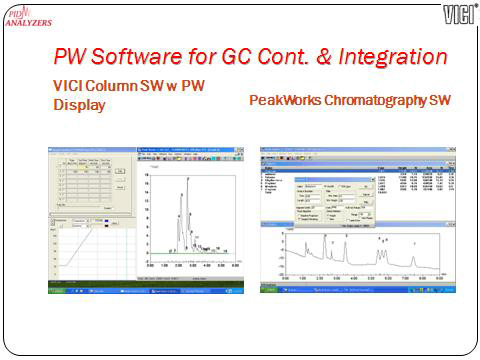
A display of the software is shown below:


An example of a fast separation of solvents and gasoline vapor by fast GC-PID is shown below:


This column separates low boiling solvents like methanol as well as high boilers like Xylene, all with excellent peak shape.


Contact PID Analyzers for more info on “The FAST GC”
PID Analyzers, LLC 2 Washington Circle, Sandwich, MA 02563; T 1 774 413 5281
url: http://www.hnu.com

Rapid Analysis of High Molecular Weight (C18 to C30) Hydrocarbons, #GC,#Fast_GC,,#C18_to_C30_ alkanes

Much of the previous work on “fast GC” utilized short (5M) thin film capillary columns to elute solutes quickly and the result is rapid but inferior separations because of the short column. New technology developed at Valco’s capillary column development center where VICI takes polyimide-coated fused silica (FST) and removes the polyimide layer. Then the (FST) is electroplated with nickel. As a result of the superior heat transfer of the electroplated nickel, we are able to rapidly and efficiently heat and achieve excellent resolution for a 30M capillary column.
 These columns can be programmed faster (hundreds of degrees/min)- save 50-90%
 The columns can be reliable started a few degrees above ambient
 These columns cool down faster because of their low mass, so savings are> 50%
Several examples of C1 to C6 HC that are given below demonstrate a > 50% reduction in analysis times:The columns can be programmed faster 50-60o/min and will cool down faster as a result of their low mass.
A schematic of the fast GC electronics is shown below:


An example of a fast separation of C18- C30 by fast GC is shown below at rates from 80 to 800 C/min is shown below. Note that even for lower program rate, the time for analysis is only 4 min.


Contact PID Analyzers for more info on “The FAST GC”
PID Analyzers, LLC 2 Washington Circle, Sandwich, MA 02563; T 1 774 413 5281
url: http://www.hnu.com

Rapid Six Second Analysis of Gases by Fast GC_PID, #GC, #PID,#Fast_GC

Much of the previous work on “fast GC” utilized short (5M) thin film capillary columns to elute solutes quickly and the result is rapid but inferior separations because of the short column. New technology developed at Valco’s capillary column development center where VICI takes polyimide-coated fused silica (FST) and removes the polyimide layer. Then the (FST) is electroplated with nickel. As a result of the superior heat transfer of the electroplated nickel, we are able to rapidly and efficiently heat and achieve excellent resolution for a 30M capillary column.
 These columns can be programmed faster (hundreds of degrees/min)- save 50-90%
 The columns can be reliable started a few degrees above ambient
 These columns cool down faster because of their low mass, so savings are> 50%
Several examples of C1 to C6 HC that are given below demonstrate a > 50% reduction in analysis times:The columns can be programmed faster 50-60o/min and will cool down faster as a result of their low mass.
A photo of the simple fast GC fluidics for gases is shown below:


An example of a fast separation by fast GC-PID is shown below:


Contact PID Analyzers for more info on “The FAST GC”
PID Analyzers, LLC 2 Washington Circle, Sandwich, MA 02563; T 1 774 413 5281
url: http://www.hnu.com

Sunday, February 5, 2012

EPA Site Program HNU GC311 #EPA_Site_Program #Photoionization #PID #GC #Gas_Chromatography

The HNU Model GC311 was evaluated by the EPA superfund Site Program.


EPA Site Program HNU GC311

Monday, January 30, 2012

Derivitizations for Improved Detection of Alcohols by Gas Chromatography and Photoionization Detection

Derivatizations for Improved Detection of Alcohols by Gas Chromatography and Photo Ionization Detection #PI...

Wednesday, January 25, 2012

NESACS Monthly Meeting is on Feb. 9, 2012

Note that the February Meeting of NESACS is on February 9, 2012 at the Holiday Inn in Brookline.


Friday, December 30, 2011

Application of the Photo Ionization Detector for the Single Determination of Hydride Forming Elements #hydrides#As_Sb_Sn_Se#ppb#photoionization#PID

An HNU photoionization detector PI52-02 was used to determine the detection limits of the following elements by hydride generation: arsenic, antimony, selenium, tin, sulfide, tellurium, bismuth, and ammonia. Detection limits were in the low ppb levels for arsenic to tin and sulfide compounds. Low ppm detection limits were obtained for tellurium through ammonia.


Application of the Photo Ionization Detector for the Single Determination of Hydride Forming Elements

Monday, December 26, 2011

Review of PID Apps in Industrial Hygiene #PID#GC_PID#photoionization#AIHA

This is an oldie but goodie paper on GC/PID applications in industrial hygiene.

Review of PID Apps in Industrial Hygiene

Monday, December 19, 2011

Derivitization of Drugs and Bio Organics by GC PID#PID#photoionization#GC_PID #Drugs#Bioorganics

This paper describes a method of improving the sensitivity of drugs and bioorganics by GC/PID.


Derivitization of Drugs and Bio Organics by GC PID

EPA Superfund Program Groundwater and Sediment Monitoring Guidance#EPA#Superfund#PID#Photoionization#GC/PID#water_sediment#VOC's

This program was developed for monitoring the cleanup of superfund sites.


EPA Sperfunnd Program Groundwater and Sediment Monitoring Guidande

Sunday, November 27, 2011

Analysis of Charcoal Tube Samples for Carbon Disulfide Using a Photo Ionization Detector,#Carbon_Disulfide_(CS2),#photoionization_PID,PID_analyzers,#AIHA

Carbon disulfide is detected @ 0.1 ppm with a 10L air sample (well below the OSHA PEL of 20 ppm) by charcoal tube collection follower by analysis by GC/PID.


Analysis of Charcoal Tube Samples for Carbon Disulfide Using a Photo Ionization Detector

Wednesday, November 9, 2011

Determination of Arsenic and Antimony Using Selective Hydride Generation and GC PID,#NSF,#Arsenic_in_water, #Antimony_in_water, #GC_PID

This paper uses an HNU (PID Analyzers) Model GC321 with a PID and selective hydride generation to measure arsenic and antimony species in water


Determination of Arsenic and Antimony Using Selective Hydride Generation and GC PID

Measurement of Arsenic in Sea Water by GC PID, #Arsenic_in_Sea_Water, #Knorr,#NSF,#GC_PID,#Arsenic_speciation,#WHOI

Measurement of Arsenic in Sea Water by GC PID, #Arsenic_in_Sea_Water, #Knorr,#NSF,@GC_PID,#Arsenic_speciati...

Testing of Chemical Warfare Agents via GD-PID,#CW-agents,#GC_PID, chemical-warfafe_agents,#PID_Analyzers.#sarin, #soman,#tabun

The testing was done at the University of Helsinki Laboratory. An HNU model GC311 with a PID (10.2 eV). The goal was to test the HNU Systems GC 311 for the verification of Chemical Warfare (CW) agents.


Materials & Methods
The CW-agents investigated in this work are listed in Table 1, The standard solutions of Model compounds were prepared in Methanol by consecutive dilutions of stock solution containing 100 ug/uL in ethyl acetate. Methanol was chosen as the solvent to eliminate a large solvent peak due to the lack of a split valve in the GC311. Methanol is not ionized by the 10.2 eV lamp.


The GC311 was equipped with a photoionization detector (10.2 eV) . The compounds were separated on a fused silica capillary column (phase NBW 311, 15M x 0.53 mm id x 1.5 um film thickness) . The injection volume varied from 2.5- 5uL. Injector/detector temperature was 200C and the oven temperature was 100 C for sarin, soman, tabun and mustard gas and 150C for Lewisite-3.

Results and Discussion.
Figures 1 & 2 show chromatograms of a standard solutions of sarin, soman, tabun and mustard gas at concentration levels of 100, 50, 4 and 1 ng. The detection limit of sarin, soman, tabun and mustard gasis about 1 ng and for mustard gas is 0.5 ng which is about 10 x better than that of the FID run at the same time. The sensitivity of the Lewisite-3 is 0.2 ng because of the 3 double bonds in that compound.


The portable GC311 has been shown to be a powerful instrument for the detection of CW-agents especially for the direct analysis of air samples. The instrument can also be used for the monitoring of incinerator exhaust gases during the destruction period of CW-agents. The analyzer could be more useful for the analysis of liquid samples if a split injector were available.
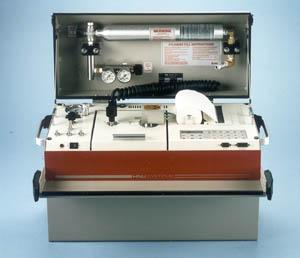
The GC311 is no longer in production but a new portable GC is available from PID Analyzers, the Model GC312.

Photo GC311 (no longer in production)


Photo GC312 (replacement for GC311)


The work in this report was done with an HNU GC311 shown above. The replacement instrument described in this report is a GC312 manufactured by:

PID Analyers,LLC,
2 Washington Circle,
Sandwich, MA 02563 T 1 774 413 5281 F 1 774 413 5298
url: http://www.hnu.com
Follow our Blogs:
http://gasdanalysis.blogspot.com
http://gcdetectors.blogspot.com
http://analyzersource.blogspot.com
Follow us on Facebook:
http://www.facebook.com/pidanalyzers

Tuesday, October 25, 2011

Review of Photoionization Detection in Gas Chromatography: The fFrst Decade

This was the first review of the photoionization detector 10 years after it was commercialized.


Review of Photo Ionization Detection in Gas Chromatography The First Decade, #Photoionization,#PID Analyzer...

Sunday, October 16, 2011

Review of Photo Ionization Detection in Gas Chromatography: The First Decade, #Photoionization,#PID Analyzers,PID,#PID_in_ gas_chromatography

This is the first review of photoionization in gas chromatography.


Review of Photo Ionization Detection in Gas Chromatography The First Decade, #Photoionization,#PID Analyzer...

Sunday, October 9, 2011

Determination of Water & O2 at Low ppm Levels by GC-FUV

The Far UV absorbance detector that can measure low ppm levels of water and oxygen has been improved by modifying the detector design.


Determination of Water & O2 at Low Ppm Levels by GC FUV

Saturday, September 24, 2011

Capillary Gas chromatographic Analysis with the Far UV (FUV) Detector #GC,#Capillary_GC.#PID Analyzers,#FUV,#ppm,#ppb

Here is an older paper on the Far UV absorbance Detector (FUV) that is a popular download on our website. The FUV can detect water, O2, and inorganic compounds at the same time as organic compounds. at ppm to ppb levels. The FUV sensitivity has been improved and this detector has been reintroduced by
PID analyzers.


Driscoll 1988 Capillary Gas Chromatographic Analysis Withthe Far UV[1]

A schematic of the FUV detector for GC is shown below:


A chromatogram of C1 to C6 hydrocarbons on a thick film capillary column follows: